Article from www.christian.art
Today we celebrate the great missionary who brought the Christian faith to Ireland and whose story continues to inspire believers around the world.
One of the most spectacular works of art connected with Saint Patrick is the Book of Armagh, created around 807 AD and now preserved in Trinity College Dublin. This remarkable manuscript is one of the earliest surviving Irish codices. A codex is simply the early form of the book as we know it today, which gradually replaced the scroll in the 8th/9th/10th centuries. The book of Armagh closely associated with the cult of Saint Patrick. It contains the earliest surviving copies of Patrick’s own writings (Confessio and Letter to Coroticus), alongside the New Testament and early lives of the saint.
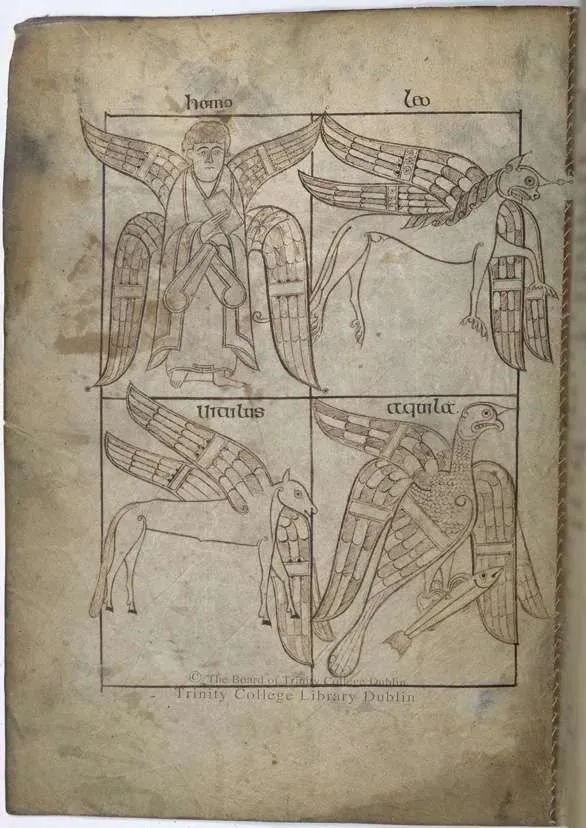
The manuscript was produced by the scribe Ferdomnach, who worked for the abbot of Armagh and deliberately compiled texts that would reinforce Armagh’s claim as the chief church founded by Patrick. One of the most striking pages in the Book of Armagh is this illustration of the four Evangelists symbolised as living creatures.
This imagery comes from the visions of Ezekiel and the Book of Revelation, where four mysterious beings surround the throne of God. In Christian tradition they came to represent the Gospel writers: the man or angel for Matthew, the lion for Mark, the ox for Luke, and the eagle for John. These symbols express the unique character of each Gospel while also proclaiming that together they bear witness to the same Christ. In the Book of Armagh the creatures are rendered in the distinctive style of early Irish manuscript art.
What makes the Book of Armagh so extraordinary is that it sits at the meeting point of history, devotion and art. It preserves Patrick’s own voice while presenting him visually in the language of early medieval sacred art. For the Irish church, this book is not just a manuscript; it is almost a relic, a physical tangible link to the missionary who brought Christianity to Ireland.