
Catholic Social Teaching (CST) addresses the big issues confronting us – work, the environment, family life, poverty, justice – and in the words of Pope John Paul II, provides us with, “a basis and motivation for action” in their monthly update by Cathy Marshall.
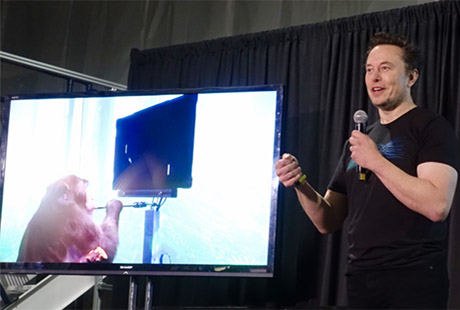
The following article was written by Cathy Marshall and was first published by The Northern Cross in their April 2025 Edition. It is based on an online article at BBC News dated 30 January 2024 (view here), written by Patrick Jackson and Tom Gerken. Image credit to Steve Jurvetson.
Mechnical devices implanted in or onto the body to help people with malfunctioning parts are nothing new – think cochlear implants, pacemakers, prostheses, and retinal implants.
Over the past few years, however, the technology has undergone a huge transformation, with brain-computer interfaces (BCIs) revolutionising medical practice. At the same time, some of these devices have raised several moral dilemmas.
The devices make use of a direct link between the brain’s electrical activity and a computer. The possibilities can be wonderful, allowing paralysed people to recover function and blind people to see again.
Among the companies inventing devices are the École Polytechnique Fédérale in Lausanne (EPFL), Switzerland, and Neuralink, in Fremont, California, both of which have recently implanted devices into the brains of human subjects connecting them to computers to alleviate the effects of complex neurological conditions, including paralysis.
Yet there can be wide discrepancies with how various companies work.
By placing electronic implants on a man’s brain and spine that wirelessly communicate thoughts to his legs and feet EPFL successfully enabled a paralysed man to walk just by thinking. The company published details of the breakthrough in the peer-reviewed journal Nature in May 2023.
Its devices are implanted inside the skull but rest outside the brain rather than within the grey matter of the brain itself – a partially invasive method.
Neuralink, however, places its implant within the brain, which is a riskier operation.
One of Neuralink’s co-founders¸ Benjamin Rapoport, left the company and founded a rival one that would only use surface electrodes because of his concern about brain damage and other safety problems.
Neuralink (www.neuralink.com) was founded in 2016 by Elon Musk and a founding team of eight scientists and engineers.
Many of the original founders have since resigned because of conflicts with safety and other concerns. Only one of them is still with the company.
Jared Birchall, the head of Musk’s family office, was listed as Neuralink’s CEO, CFO and president in 2018.
As of September 2018, Musk was its majority owner but did not hold an executive position. There is no mention of Musk on the company’s website, but in media reports Neuralink is still routinely termed as ‘Elon Musk’s company’ and he often acts as its spokesperson.
Musk, one of the world’s wealthiest men, is obsessed with science fiction and known for pushing boundaries.
According to Jenny Kleeman of the Guardian: “No regulator has yet allowed BCIs to be used outside an experimental setting”, which shows that there are still serious questions about this technology.
In September 2023, the US Food and Drug Administration did give Neuralink an “investigational device exemption” that allowed it to recruit participants for human trials.
Musk has recently claimed great success on the part of Neuralink in giving a quadriplegic man the power to control computers with his mind.
There has been no independent verification of Musk’s claims, nor has Neuralink provided any information about the procedure he says has taken place. The company has also not given scientists the opportunity for peer review, which is something the scientific community holds almost sacrosanct when it comes to research.
In 2018, Gizmodo – a design, technology, science and science fiction website – reported that Neuralink “remained highly secretive about its work”.
According to Kleeman: “This avoidance of external scrutiny has led medical ethicists to describe Neuralink as ‘science by press release’. Musk’s impatience for eye-catching results is likely to increase….”
Indeed, Musk predicts that hundreds of millions of people will have Neuralink implants within the next two decades, maintaining that it would give people superhuman abilities.
In April 2017 Neuralink announced it was aiming to make devices to treat serious brain diseases, with the eventual goal of human enhancement, sometimes called ‘transhumanism’.
Musk has said his interest in the idea partly stemmed from the concept of ‘neural lace’ found in a series of ten science fiction novels by Iain M. Banks.
The mention of transhumanism as a goal of Neuralink can be quite disturbing. Transhumanism advocates various scientific technologies – such as genetic engineering, cryonics, artificial intelligence and nanotechnology – to augment human capabilities and improve the human condition.
That may all sound very laudable, but transhumanists want to apply such technologies in humans to slow, reverse or eliminate the aging process, thus leading to significant increases in human life spans, sometimes bizarrely saying they foresee an end to death itself.
Worryingly, the movement proposes that humans with augmented capabilities will evolve into an enhanced species that transcends humanity – the ‘posthuman’.
This sounds very much like a morally questionable and scary successor to the forms of eugenics that gained some followers in the 20th Century.
Is the Neuralink implant a lifechanging innovation that could help millions, or is it the start of a dystopia whereby a billionaire can access our every thought?
The biggest ethical concern at present is mind control. If the implant allows the mind to control the computer directly, might it not also allow the computer to gain control of the person’s mind? A chilling thought.
Neuralink has been criticised many times in the past, with Reuters reporting in December 2022 that the company’s testing had resulted in the deaths of approximately 1,500 experimental animals.
Animals also experienced chronic infections, paralysis, swelling in the brain, a loss of co-ordination and balance, and depression. Additionally, several Neuralink employees claimed that testing was being rushed due to Musk’s demands for fast results.
Neuralink’s pioneering BCI case, Nolan Arbaugh, became quadriplegic after a diving accident. Before being chosen he attended several rounds of interviews and assessments then had to sign a 35-page consent form, which included an exhaustive list of risks.
After the operation, Musk immediately claimed great success. But has it been? There needs to be a note of caution as true success can only be evaluated in the long term.
Arbaugh has had both good and bad results. He was able to control the computer to an extent, but only a month after receiving the BCI, the implant stopped working.
Arbaugh wanted additional surgery, but the neurosurgeon was reluctant to perform another operation. Neuralink tweaked the remaining 15 per cent so that they still work, but such experiences demonstrate exactly how risky BCI implants can be.
Reality also kicks in, and it doesn’t look very good for Arbaugh.
When the experimental study ends, Neuralink will either remove his implant or simply switch it off. The company cannot promise there will ever be any upgrade, which seems quite heartless.
Essentially, he’s been used as a guinea pig for a billionaire’s ego trip.
How moral is all of this?
The complexity of today’s world brings numerous challenges about what the right thing to do in specific circumstances might be.
How to be a good Christian sometimes seems to be more difficult than ever before.
One of the fundamental principles of Catholic Social Teaching is the primacy of the common good. In principle, we should always have the common good as a basis for all our actions.
But this can be difficult indeed when the real and serious needs of individuals come into conflict with what would seem to be the common good, as is the case when severely challenged people might possibly benefit to a great extent by ethically questionable means. Would it permissible to make exceptions?
Surely there is a need for pioneers and people willing to undergo risks in order that others might benefit. But exactly how far can that be supported, given the very wide latitude some companies have for pushing boundaries?
BCIs provide a very good example of how CST is never finished.
Life is always throwing up new challenges, and CST needs to face them and shed light on them, offering principles that are based on Christian teaching.
Often scientific innovations are presented as faits accomplis before any questions have been asked about how ethical they might be. In such cases, scrutiny is urgently needed.
But who actually makes decisions on ethical issues?
Bioethical questions are typically decided through collaboration involving members of many occupations. Healthcare professionals, bioethicists, religious leaders, legal representatives, various types of stakeholders, researchers and even patients and the public provide input. Ethics committees, government bodies and professional organisations may also be involved. Ultimately the aim is to achieve a balance between ethical principles and societal values, including legal frameworks.
With such a large cohort, however, there can be huge differences of opinion about what constitutes unethical actions.
Among the ethical questions raised by BCIs include concerns about privacy, autonomy, consent and the consequences of merging human cognition with external devices. Exploring these ethical considerations highlights the complex interplay between advancing technology and preserving fundamental human rights and values.
Some concerns relate to the safety and long-term effects on users – including health-related side effects, the misuse of therapeutic applications, safety risks and the non-reversible nature of some BCI-induced changes.
Additionally, questions arise about access to maintenance, repair and spare parts, particularly in the event of a company declaring bankruptcy.
Legally, issues arise over accountability and responsibility, such as claims that the implants override free will and control actions. And in addition to known complications such as infection, haemorrhage and even brain damage, there may be inaccurate translation of cognitive intentions, personality changes resulting from deep-brain stimulation and the blurring of the line between human and machine.
Other concerns involve the use of BCIs in advanced interrogation techniques, unauthorised access (‘brain hacking’), privacy issues related to mind-reading, tracking and tagging systems, and the potential for mind, movement and emotion control.
In their current form most BCIs are more akin to corrective therapies that have only a few ethical issues. As Nolan Arbaugh’s experience bears out, however, there are exceptions.
We can be thankful and reassured that the BCI community essentially understands the need and is already working to create consensus on ethical guidelines for research, development and dissemination. They can’t even begin, however, unless they are informed about what is being done, and many companies do not undergo any scrutiny or peer reviews which would allow questions and problems to be addressed before they go too far.
To foster the common good, we desperately need means of keeping the less ethically oriented companies from going off half-cocked in pursuing ideas that may well result in serious side effects or other hazards.