
Article from www.christian.art
Solemnity of St Joseph, husband of the Blessed Virgin Mary
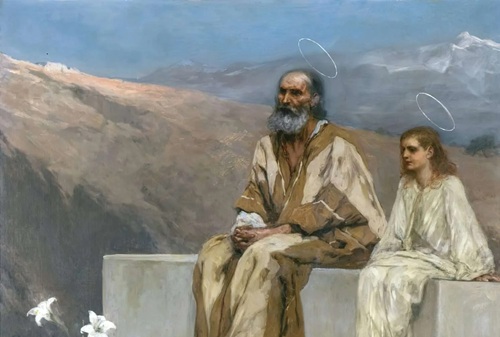
Most paintings during the course of art history, show St Joseph either asleep dreaming, or holding the infant Jesus in his arms. Not here. Instead, Joseph sits quietly beside his Son, who is depicted as a boy in his early teens. They are not looking at each other; rather, they both gaze forward into the distance. It is a powerful detail. The earthly father and Son share the same horizon. The same focus. The painting suggests a quiet communion of destiny. Joseph was not merely a spectator in the unfolding of God’s plan of salvation. He was entrusted with a role within it. Here he sits beside his Son; not ahead of him, not behind him… but faithfully alongside him, accompanying him on the path that lay before them.
What makes St Joseph so extraordinary in the Gospels is that he never speaks a single recorded word. Not one sentence of his is preserved in Scripture. And yet his life speaks volumes. Joseph is the quiet guardian of the Holy Family, the man who faithfully protects Mary and Jesus Christ, guiding them through danger, providing for them with the work of his carpenter’s hands, and trusting God even in great ,moments of insecurity. The last time Joseph appears in the Gospels is during the episode of the Finding of Jesus in the Temple, when Jesus is twelve years old. After that moment Joseph disappears from the Gospel narrative.
This silence has led many to believe that Joseph likely died sometime during Jesus’ youth, meaning that Jesus may have known the sorrow of losing his earthly father while still a teenager. We don’t know for sure. But what we do know is that Joseph’s quiet presence must have left a deep mark on Jesus’ life: a model of faithful, humble love that speaks not through words, but through loving action.
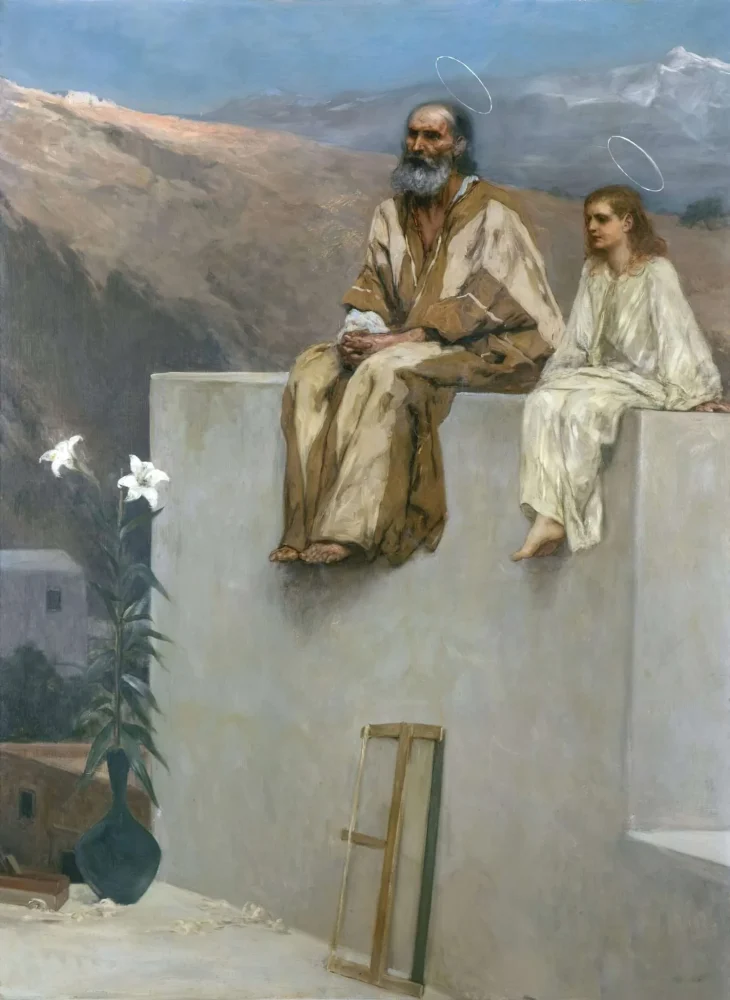
Saint Joseph, Foster Father of Christ,
Painted by François-Jean-Baptiste-Benjamin Constant (1845-1902),
Painted in 1890,
Oil on canvas
© Saint Martin Church, Villers-sur-Mer, France